
Magnus Heystek 20/06/2016
Let me be upfront about this: I didn’t see it coming.
Having been burnt so many times in the past by the capricious and unpredictable nature of gold and gold shares I’ve been hot-wired to interpret any sudden upward movement in the price of this ‘barbaric relic’ as the sceptics call it, as temporary, just waiting for my decision to enter the market before it begins yet another downward swoon.
And so it was again for many years, particularly with regard to South African gold shares, and over this time I often commented that I wouldn’t touch gold shares with a barge pole.
But as faraway friend and former stockbroker Neville Stevens-Burt (now living in Malaysia), keeps reminding: “We are now approaching the end-game. It’s time to protect yourself against the financial calamity that is rapidly unfolding. Buy gold and gold shares.”
But as I said in the introduction, if you’ve been in the financial world as long as I have, you’ve heard and read such warnings too often to react to them all the time. And for good reason: most of these ‘end-game’ predictions have been wrong. Yes, markets have swooned and crashed, sometimes spectacularly – the last time during the 2007/8 Great Financial Crisis, when markets plummeted by more than 50% in about four months. But by and large markets have recovered and the financial edifices of the financial world are still standing.
I have a number of books predicting financial doomsday in my library, including one written by Robert Kiyosaki (Prophecy, 2002), and all of them bear testimony to the folly of making such definitive, bold forecasts. But they all prey on fear inbred in the human race and many of them sell well and become a talking point for a short period of time.
How can interest rates be negative?
But I must admit that the rumblings of financial discontent, which are getting louder and closer all the time – akin to a rolling thunderstorm on the Highveld – have me worried. I’ve spent considerable time in recent weeks trying to understand this extraordinary period we are in right now: global negative interest rates.
We now have, according to recent reports, about $10 trillion dollars’ worth of government debt across the globe trading at negative interest rates. The latest country to join this mad scramble was Germany last week, where the rate on the ten-year Bund dropped below 0%, the lowest yields in over 500 years!
Nowhere have I came across any credible explanation from any recognised economic commentators. I’ve even been spending some time on off-centre financial websites to try to find answers. And there were plenty, none of which I liked. In short – if you believe in the majority of contributors to these sites – it’s all over for financial markets and the Big Crash is coming our way. Sort of like the movie Independence Day.
Why the sudden gloom?
Interest rates in countries such as Norway, Switzerland and others have been negative for a while and now Germany has joined them. This is not a small, peripheral country – it’s the fourth largest economy in the world and the sharp drop in rates to -0.02% this week sent shockwaves throughout the banking system in Germany. It is costing German banks billions of dollars in fees and reducing the savings pool for future generations. Imagine being a German life assurance company that has to buy certain assets today to provide for a future, unknown liability ten or 20 years away for its future pensioners.
That’s right: savers are so petrified at the moment that they are prepared to forfeit as much as 2% per year of their capital to the issuer of the instrument. This collective action by savers/pension funds/retirement funds indicates that right now return of capital has become more important than the return on capital.
In the US, rates are still positive but on Thursday the yields on ten-year Treasury Bills dropped – which means the price went up – to 1.58%, the lowest in almost four years.
The US market has also been spooked by comments made by Republican nominee for the presidential race Donald Trump, saying that the US can never go broke…all it needs to do is print more money.
Still fighting the inflation beast
Let’s just stop to think about it for a minute as it’s not an issue widely debated in local financial circles. Our financial issues are totally different: here we fear higher interest rates, a declining currency and an inflation rate that’s just itching to head higher as a result of drought, the currency decline and administered prices. Local investors are more focused on getting a return on their investments that will match or beat the inflation rate which, over the last two years, has become significantly more difficult to do than in the recent past.
Gold, and to a lesser extent silver, have been the major beneficiaries of the era of global negative interest rates. If bonds are earning less than zero and a generalised period of deflation ensues, then by definition an asset class that returns zero percent offers an attractive option. This is what seems to have been driving the renewed demand for physical gold over the past eight months or so. And because gold shares were so depressed for a number of years, the whipsaw reaction since then has been spectacular.
The continued delay by the US Federal Reserve to further increase interest rates (the increase was postponed yet again on Wednesday evening by Fed governor Janet Yellen) is also playing into the hands of the gold bulls. Higher US interest rates are anathema to higher gold prices and vice versa. There is a feeling that the US Fed has missed the boat in terms of raising interest rates and rates are unlikely to be raised anytime soon, especially considering the deflationary blanket that has descended over global financial markets.
The accompanying graph of the performance of the Old Mutual (local) and Investec (global) gold funds – two vehicles that give South African investors direct access to gold shares – shows just how unpredictable it’s been to determine if the turnaround in the fortune in gold shares has been the real thing.
(Click image to enlarge)
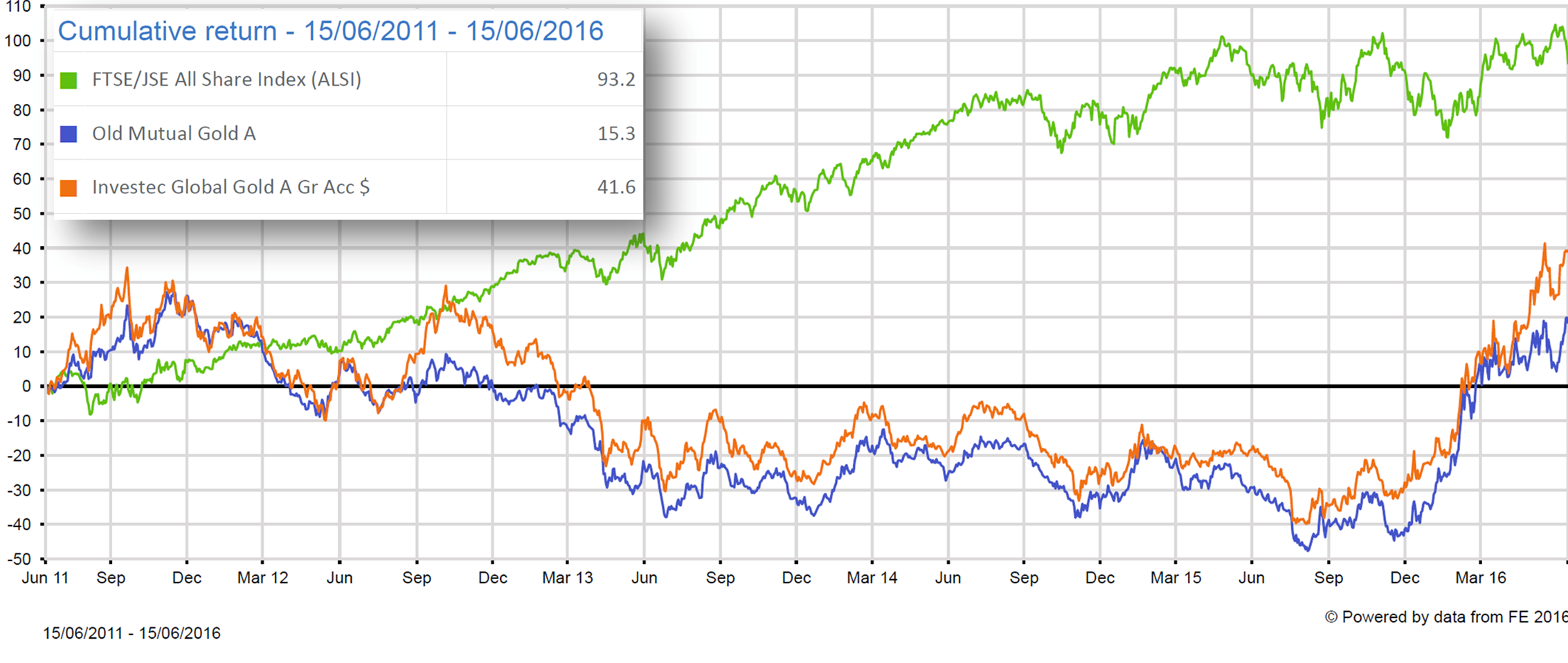
The bear market in gold shares lasted more than four years and intermittent upticks in prices proved to be a false alarm. That is, until the market bottomed some time around December last year – since then the market has almost doubled.
It’s not a retail market favourite and it’s not the kind of investment you could have recommended to your clients unless you were prepared to face the wrath of the Fais Ombud if your call turned out to be wrong, once again. That’s why there has been no flood of money into the Old Mutual Gold or the Stanlib Gold and Precious Metal funds since the upturn started.
John Biccard, who runs the Investec Value fund, has had a large exposure to gold shares for quite some time and he has since the end of November shot the lights out as far as returns are concerned. However, many investors bailed from this fund and were not able to stomach the gut-wrenching under-performance for such a protracted period of time.
Biccard has to be commended for sticking to his guns in the face of widespread criticism, from me too. It’s still not a fund I would or could recommend to widows and orphans.
Too late to join the bull run?
The big question now is what should investors do? Is it too late to board this rapidly-accelerating train or is the derailment just around the first corner, as yet unseen?
This is why an investment in gold shares is such an exhilarating, stomach-churning ride. Get it right, like my friend Stevens-Burt, and you are floating on a cloud of profits.
Get it wrong and you slink away to sulk, all alone with no one wanting to hear yet another tale of woe.
And furthermore, where do you buy your gold shares: here in sunny SA or do you send some dosh abroad to invest in a more globally-diversified gold mining portfolio – a strategy that seems to have worked better than staying local. Or do you buy NewGold or Krugerrands?
From a technical perspective the increase in both the gold price and gold shares has been very positive, signaling higher levels in the weeks and months ahead. But, once again, it’s not for the fainthearted or for people who shop on Tuesdays to get discount on milk and bread.
*Magnus Heystek is the investment strategist at Brenthurst Wealth. He can be reached at magnus@heystek.co.za for ideas and suggestions.